
How to Tell AC Refrigerant Leak Signs
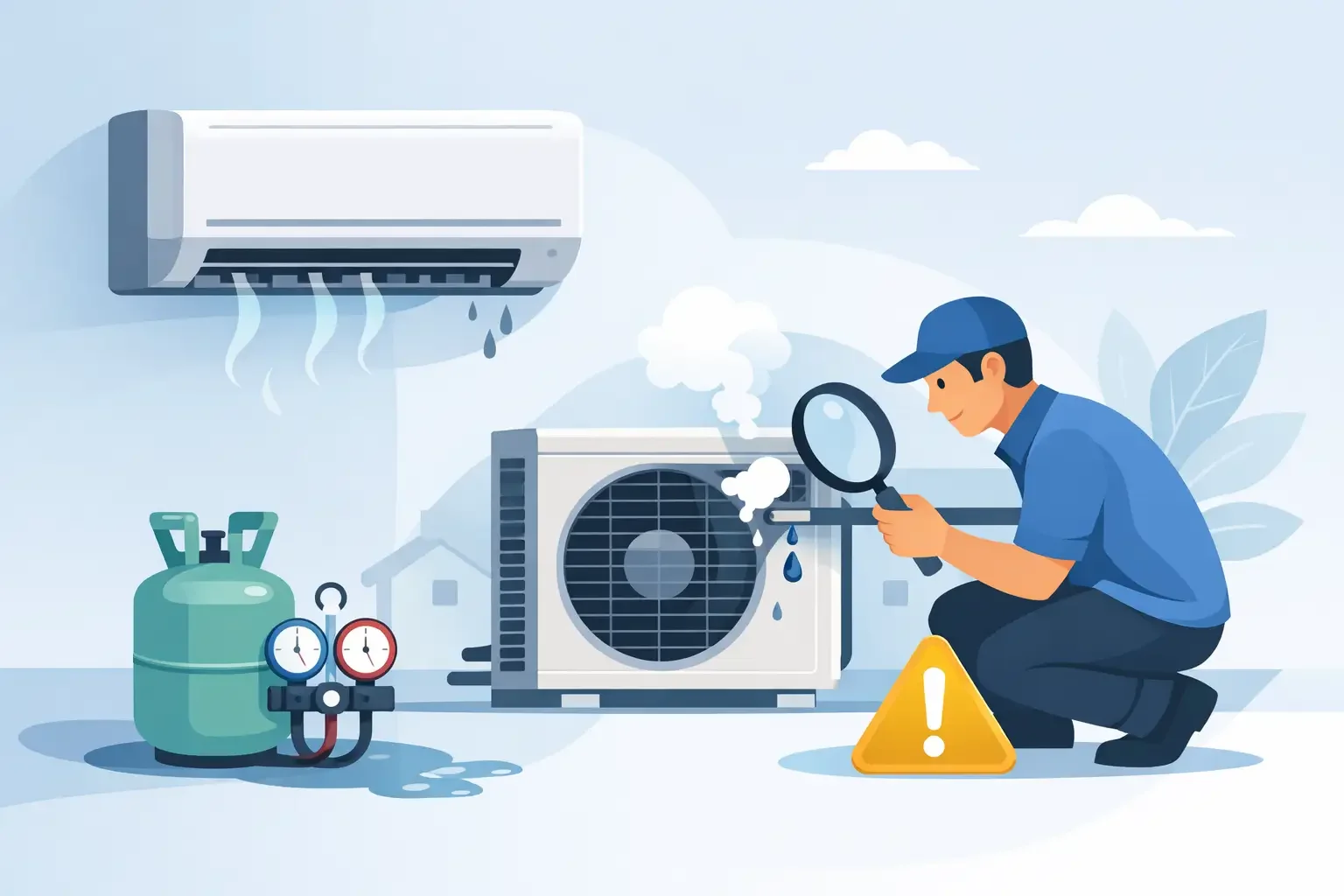
When your AC runs all day in Las Vegas and the house still feels sticky, warm, or uneven, something is off. If you are wondering how to tell AC refrigerant leak problems from more common issues like a dirty filter or thermostat setting, there are a few warning signs that tend to show up together.
Refrigerant is the chemical your air conditioner uses to absorb heat from inside your home and move it outdoors. In a sealed system, it should not run low under normal conditions. That means if your system is short on refrigerant, there is usually a leak somewhere in the lines, coils, or fittings. Topping it off without finding the leak is usually a temporary fix, not a real repair.
How to tell AC refrigerant leak issues at home
The first clue is often weak cooling. Your AC may still turn on, the fan may still blow, and air may still come through the vents, but it does not feel as cold as it should. Some homeowners describe it as the system "running but not catching up," especially during the hottest part of the afternoon.
Another common sign is longer run times. When refrigerant is low, the system has a harder time removing heat. That forces it to work longer to reach the thermostat setting, which can send your power bill up even if your thermostat habits have not changed.
You may also notice rooms cooling unevenly. One side of the house might feel acceptable while another stays warm. That can happen with airflow problems too, so it is not proof of a refrigerant leak by itself. Still, when uneven cooling shows up alongside warm supply air and long cycles, refrigerant becomes more likely.
The most common refrigerant leak symptoms
A refrigerant leak usually creates a pattern, not just one symptom. The strongest signs include poor cooling performance, ice on the indoor coil or refrigerant lines, hissing or bubbling sounds, and higher energy use.
Warm air or reduced cooling
If you hold your hand near a supply vent and the air feels room temperature or only slightly cool, your system may not be absorbing enough heat. That does not always mean low refrigerant. A clogged filter, dirty evaporator coil, failing blower motor, or bad capacitor can create similar complaints. But if your filter is clean and the system still struggles, refrigerant loss moves higher on the list.
Ice on the refrigerant line or indoor coil
Homeowners are often surprised by this one. Low refrigerant can cause pressure to drop inside the evaporator coil, which can make the coil get too cold. Moisture in the air then freezes on the coil or line set. You might see frost or ice on the copper line near the outdoor unit, or you may notice water around the air handler after the ice melts.
This is one of those situations where it depends. Ice does not automatically mean a leak, because restricted airflow can also freeze a coil. A dirty filter, blocked return, or blower issue can do the same thing. That is why proper diagnosis matters.
Hissing or bubbling sounds
A small refrigerant leak can make a faint hissing noise as refrigerant escapes under pressure. A larger leak may sound more like bubbling. These sounds are easy to miss, especially near an outdoor unit in a noisy neighborhood, but if you hear them consistently when the system starts or runs, they should not be ignored.
Higher electric bills
An AC that cannot cool efficiently has to run longer. In Southern Nevada, that can show up fast on your monthly bill. If your energy use spikes without a major lifestyle change, and your home still feels less comfortable than usual, a leak is one possible reason.
What a refrigerant leak does to comfort in a desert climate
In Las Vegas and Henderson, an AC problem does not stay small for long. Extreme afternoon heat puts a lot of strain on your system, so even a slow leak can turn into a comfort issue pretty quickly. A unit that seems "mostly fine" in the morning may fall behind by late afternoon when outdoor temperatures peak.
That is one reason homeowners sometimes delay service. The system still cools a little, so it feels like something you can watch for a week or two. The trouble is that low refrigerant can stress the compressor, and compressor repairs are far more expensive than catching the issue early.
Signs that are often confused with a refrigerant leak
Not every AC problem points to refrigerant. Dirty air filters, thermostat issues, bad contactors, drain line problems, and failing motors can all affect performance. If your AC is not cooling, the real problem might be simple.
A dirty filter, for example, can reduce airflow enough to make the house feel warm and even cause coil icing. A thermostat with weak batteries or poor calibration can make the system cycle at the wrong times. A clogged condensate drain can shut some systems down entirely. That is why honest diagnostics matter. You do not want someone jumping straight to "you need a whole new system" or adding refrigerant without confirming where the problem actually is.
How technicians confirm a refrigerant leak
A proper diagnosis goes beyond guessing based on temperature alone. A licensed technician checks refrigerant pressures, coil temperatures, airflow conditions, and overall system performance. If those readings point to low charge, the next step is finding the source of the leak.
Leak detection methods
Depending on the system and the suspected location, a technician may use an electronic leak detector, soap bubble solution on accessible joints, ultraviolet dye, or nitrogen pressure testing. Each method has its place. Some leaks are obvious at a coil connection. Others are tiny and take more time to pinpoint.
This is where experience matters. The right repair depends on where the leak is, how large it is, the age of the equipment, and the condition of the rest of the system.
Repair or replace? It depends on the system
If the leak is at a service valve, fitting, or braze joint, repair may be straightforward. If the evaporator coil or condenser coil is leaking, the decision can be less simple. Coil replacement can make sense on a newer system in otherwise good shape. On an older unit with multiple issues, replacing the system may offer better long-term value.
There is no one-size-fits-all answer here. The honest approach is to look at repair cost, equipment age, warranty status, refrigerant type, and how well the unit has been cooling before this issue showed up. That is especially true if your system uses an older refrigerant that is getting more expensive and harder to source.
What you should do if you suspect a leak
Start with the basics. Check your thermostat setting, replace a dirty filter if needed, and look for visible ice on the refrigerant line or around the indoor unit. If you see ice, turn the system off and switch the fan to ON if your thermostat allows it. That can help thaw the coil before service.
Do not keep forcing the system to run if it is clearly struggling. Running an AC with low refrigerant can damage the compressor, and that is one repair no homeowner wants in the middle of summer.
It is also smart not to assume refrigerant just "runs out." It does not work like fuel in a car. If refrigerant is low, there is a leak somewhere, and the right fix is to identify it, repair it when practical, and recharge the system to the manufacturer specification.
When to call for professional AC service
If your AC is blowing warm air, freezing up, making hissing noises, or driving up your electric bill while cooling less, it is time to get it checked. The sooner the issue is diagnosed, the better the odds of avoiding a bigger repair.
For local homeowners, this is where a service company should act like a repair team, not a sales team. At Mr. Gates HVAC, that means looking at what is actually wrong, explaining it clearly, and giving you a practical recommendation based on your system and your budget.
A refrigerant leak is not something to ignore, but it also is not something to panic over. Catch it early, get a real diagnosis, and you will have a much better shot at protecting your comfort before the next triple-digit day hits.